
Trump's Monuments Man
What cultural agenda will Rodney Mims Cook be handed in St. Petersburg?

REMINDER: I published a new class as part of my Foreign Influence Operations course.
CLASS 21: WHY ARE THE FRENCH STEALING AFRICAN PENISES? is an in-depth look at Russia’s industrial-scale information operations in Africa and outlines why it matters. I hope you’ll check it out.


A friendly reminder that Rant! is a reader-supported publication. Thank you for making this newsletter possible!
ALEX’S WEEKLY RANT!
Midweek brought a beautiful sight. Attendees of the St. Petersburg International Economic Forum were greeted by black smoke swirling high over the city after Ukraine struck several military and energy sites with drones the morning of the opening of Putin’s big event. Anyone attending the forum is, in my opinion, willingly presenting themselves to be exploited by Putin’s regime. So it is only apt they be greeted by Ukrainian drones.
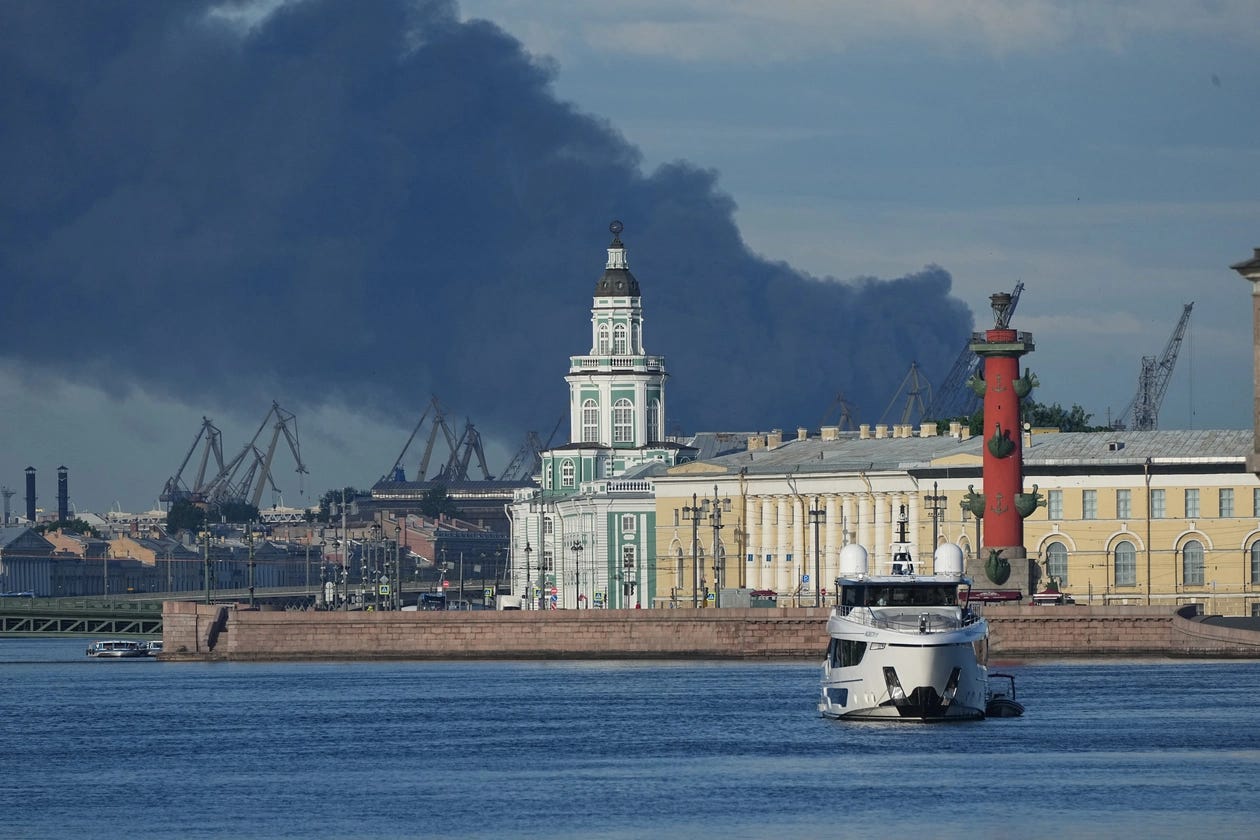
The annual St. Petersburg International Economic Forum, commonly referred to as Putin’s Davos, aims to spur business and economic opportunities by encouraging investment into Russia. It is also known to be a major recruitment ground for Russian intelligence, for whom the forum is a chance to recruit new assets and have face-to-face meetings with those who are already recruited and hand them their marching orders.
Since Russia’s full-scale invasion of Ukraine in 2022, western participation in the event has dropped significantly. But this year, the event is seeing an uptick in attendees from Europe and the US. Not surprisingly, a number of members of Germany’s Alternative for Germany (AfD) party are there. The party is very open about its relations with Russia. A senior AfD official met with the CEO of Gazprom to discuss reopening Nord Stream, among other business opportunities. Also attending is Candace Owens, the American right-wing firebrand who found herself in litigation with the French president after insisting France’s first lady was a man. She will participate in a panel on family values. She is accompanied by her husband, George Farmer, a close ally of Nigel Farage in the UK and former head of Turning Point UK, the British version of Charlie Kirk’s Turning Point USA.
Another high-profile American in attendance is Rodney Mims Cook, the head of Trump’s Commission on Fine Arts, the group that approved Trump’s ridiculously large arch and is shepherding the White House ballroom project. Cook is slated to speak at the forum’s Russia-US “Dialogue of Cultures” session, which, according to Yuri Ushakov, an aide to Putin, will focus on the “US-Russian cultural agenda.” Cook will be joined by Valery Gergiev, director of the Bolshoi and Mariinsky theaters, Mikhail Piotrovsky, director of the Hermitage Museum, American Chamber of Commerce in Russia President Robert Agee, Russian oligarch Viktor Vekselberg, and Steven Seagal (yes, seriously).
What exactly is the “US-Russian cultural agenda”? What is Cook’s role in that agenda? And what is Steven Seagal’s play here? He has spent the last few years training the Russian military in martial arts and evading rape allegations. Is he planning a comeback in the US? Will he perform at the Bolshoi? Will the Hermitage do an exhibit about his ponytail?

I am very curious about Cook’s participation in this panel and I can’t help but think there are sinister objectives at play, both by Putin and by Trump.
We know Russia has used “cultural exchanges” for influence purposes. Major cultural events have been a common target for manipulation, as well. The return of Russia to Venice’s Biennale this year has caused controversy, for example. We have also seen many examples of Putin manipulating history to reshape the information space and make it a more easily exploitable environment for his purposes. Monuments have played a key role in this.
Monuments are symbols of what we choose to honor and prioritize in our history. What stories we tell is about power: it defines what we deem worthy of preservation, memory, and honor and what we consider expendable.
We’ve seen examples of political controversies involving monuments in the US, of course. Think of the putting up or tearing down of Confederate monuments. But Russia is particularly good at using monuments to manufacture political outrage, rewrite history, and project power. There is a reason you had statues of Lenin everywhere during communist times, and why when they are taken down the Russians scream about “Russophobia.” Never let a good controversy go unexploited!
Let’s look as an example at the statue of Vladimir the Great in Moscow. Putin (Vladimir the Not So Great) unveiled the 52-foot statue on National Unity Day in 2016, two years after Russia annexed Crimea. (National Unity Day, by the way, is a national holiday Putin revived in 2005 to celebrate the Russian Empire and its desire to expand, because again, what we celebrate writes our history and designates power.)
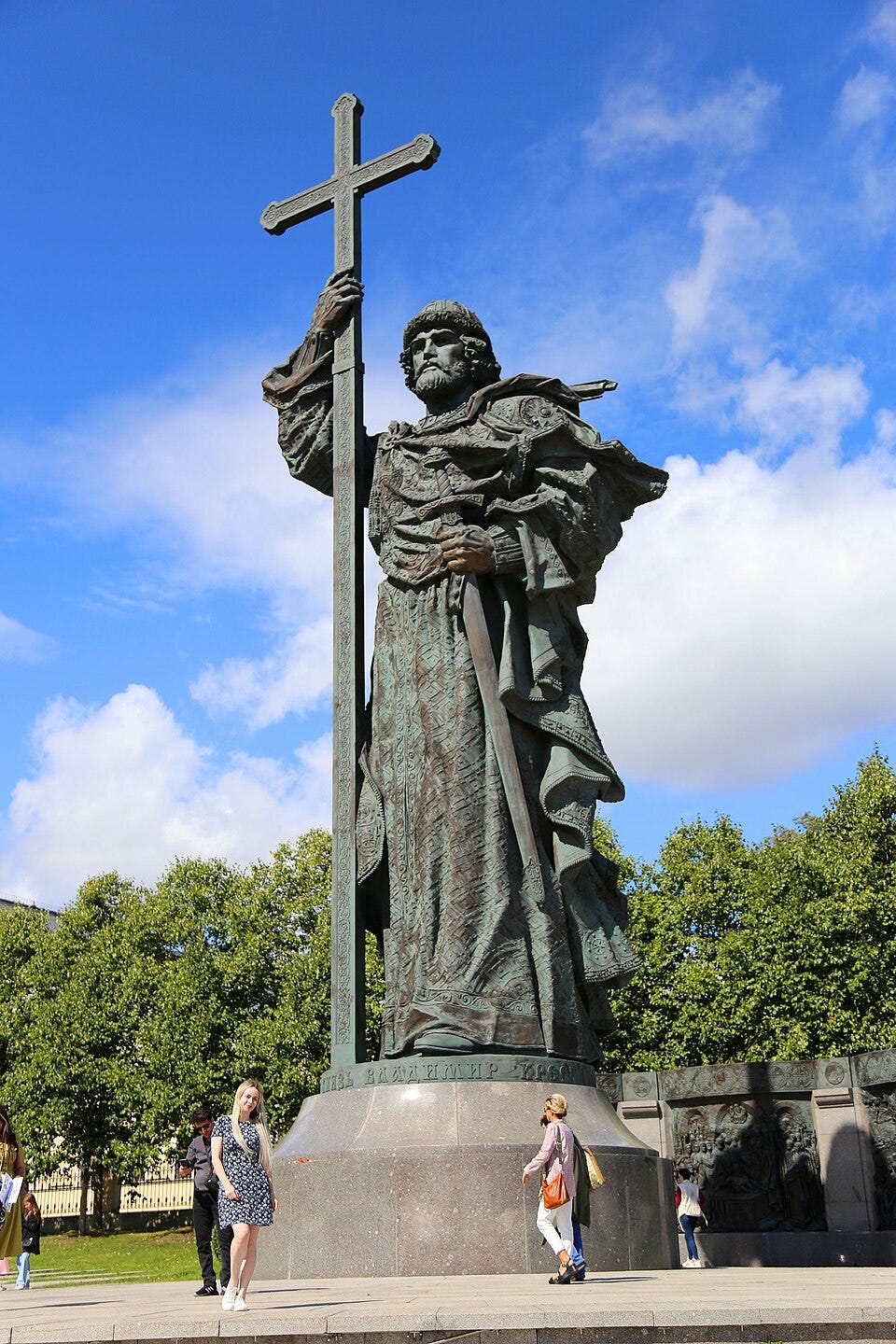
Vladimir the Great is credited with introducing Orthodox Christianity, hence the enormous cross. By putting up a monument honoring this, Vladimir the Not So Great aimed to paint himself as a defender of the Orthodox Church and traditional values. It’s an image Putin has cultivated and used to infiltrate and form alliances with right-wing political groups across the globe. (The Russian Orthodox Church is also known to work closely with Russia’s intelligence services.)
But the statue was also meant to spark tension with Ukraine. Vladimir the Great was the Grand Prince of Kyivan Rus, the first East Slavic state. He ruled from Kyiv and Ukraine claims him as a founding father. A monument was built in Ukraine’s capital in the 19th Century to commemorate Saint Volodymyr, as he is known there, for converting Kyivan Rus to Christianity in 988, more than 150 years before any written documentation of Moscow appeared in 1147.
Putin used the monument as a deliberate provocation of Ukraine and to hammer home the message that he views Kyiv as part of Moscow’s rule.
Outside Russia, too, Russia has used monuments for political purposes. Take a look at the Bronze Soldier in Tallinn, Estonia.
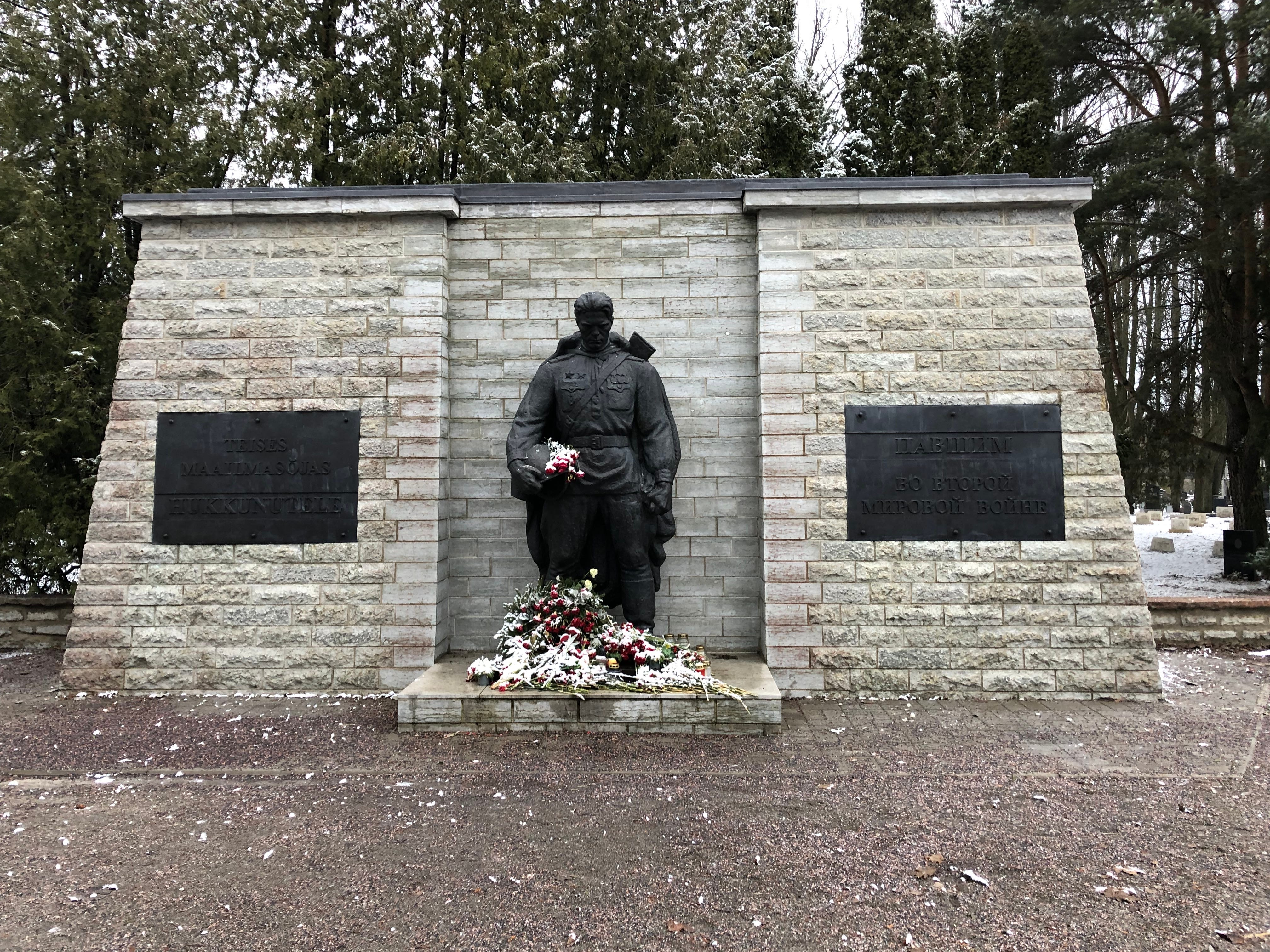
Shortly after the Soviets occupied Estonia, they erected a wooden monument topped with a red star in Tallinn to honor their fallen Red Army comrades. That wooden monument was blown up in 1946 by two teenage girls, ages 14 and 15, who, in their own words, destroyed the Soviet memorial to avenge the Soviets’ destruction of monuments built to memorialize Estonia’s war of independence. The two teenagers were later arrested by the secret police and shipped off to the gulag.
Then, in September 1947, on the third anniversary of the Soviets’ arrival in Estonia, Soviet officials unveiled the Bronze Soldier on the same spot where the wooden monument had been. It was meant to celebrate the USSR’s “liberation” of Estonia from the Nazis. As such, the statue was called the Monument to the Liberators of Tallinn.
This title was deceptive, however. Estonia reestablished an independent government after the Nazi occupiers retreated in 1944. When the Red Army marched into Tallinn later that year, it was marching into the capital of an independent country, thus liberating Estonia from itself before occupying it for the next half century.
In 1964, Soviet officials added an eternal flame that turned out not to be eternal after all. When Estonia again regained its independence in 1991, the Bronze Soldier was rebranded “For those fallen in World War II” and the flame was put out.
But the Bronze Soldier’s saga doesn't end there. In 2006 and 2007, the statue became a lightning rod for controversy. Estonian nationalists called for the monument to be destroyed. This didn’t sit well with the many Russians who still lived in Estonia. Added to the tension was the fact that the monument was on a burial site, giving the Russians an opportunity to bark about the blasphemy of disturbing the bones of the Red Army “liberators.” Riots and violence erupted. On 27 April 2007, after the first night of rioting, Estonia decided to move the statue to a different location. By sheer coincidence, on that same day, there was a massive coordinated cyber attack against Estonian institutions, including its Parliament, banks, and media.
All this to say: Russia has long been adept as manipulating public monuments for political purposes. Putin has continued this tradition.
Rodney Sims Cook, Trump’s monuments man, has already proven his willingness to promote and execute Trump’s personalist agenda. What cultural ideas will be presented to him in St. Petersburg to encourage him and Trump to carry out actions or launch initiatives the Kremlin will then exploit for its own advantage? Because I can’t imagine we’re too far from seeing something like this being proposed for the National Mall and Cook’s Fine Art’s Commission giving its sign off:
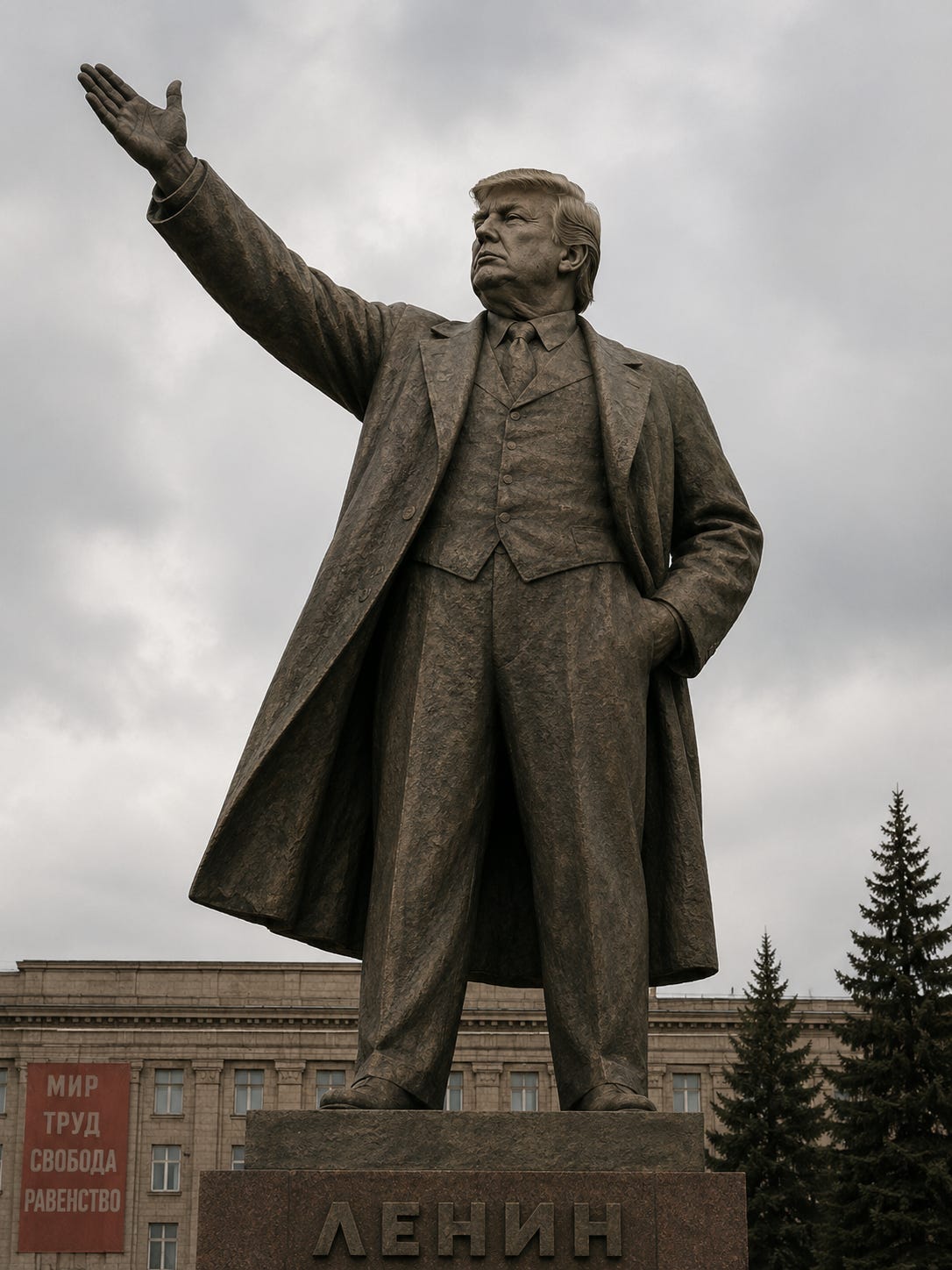
Why is there a US-Russia cultural agenda at all? What good culture has Russia given the world over the last century? Its legacy is one of cruelty and washed up martial arts actors. No American should even be at the St. Petersburg forum, let alone speaking about a US-Russia cultural agenda. There is nothing from there we should be celebrating and honoring. The fact that Trump’s monuments man is there to discuss this shows what Trump wants to celebrate and honor: cruelty, provocation, and manipulation. And Steven Seagal’s ponytail.
THE WEEK’S LINKS
A roundup of things you should be reading
RUSSIA
Putin and Russia’s legacy of military cruelty (The Washington Post)
Working For A Secret Family: The Foreigners Raising Putin’s Purported Sons (RFE)
Russia condemned me to death and now the truth is on trial (Shaun Pinner)
EUROPE AND THE RUSSIAN SHADOW FLEET
Russian shadow fleet enabled by EU-linked insurers, investigators say (Politico)
INSURRECTIONISTS AMONG US
Pentagon hires convicted Jan. 6 rioter for sensitive counterterrorism job (The Washington Post)
EXCELLENT RESOURCES!
Just Security has launched WHAT JUST HAPPENED? as well as a litigation tracker to help readers keep up with the chaos
Alex Finley is a former officer of the CIA’s Directorate of Operations, where she served in West Africa and Europe. She writes and teaches about terrorism, disinformation / covert influence, and oligarch yachts. Her writing has appeared in Slate, Reductress, Funny or Die, POLITICO, The Center for Public Integrity, and other publications. She has spoken to the BBC, MSNBC, CNN, C-SPAN’s Washington Journal, France24, and numerous other media outlets. She was also invited once to speak at Harvard, which she now tells everyone within the first ten seconds of meeting them. She is the author of the Victor Caro series, satirical novels about the CIA. Before joining the CIA, Alex was a journalist, covering Capitol Hill, the Pentagon, and the Department of Energy. She reported on issues related to national security, intelligence, and homeland security. Did she mention she was invited to speak at Harvard?
Alex, Excellent topic, analysis, and conclusions, such as they are. I'm so glad I clicked on your email. I look forward to your future work, and to partner with you moving forward. Slava Ukraini!
Thank you for your post, Alex. Thank you.